






Pool float materials Australia: a guide to choosing the right option
Share
Australia is not one climate, and each part of the country is tough on pool floats in a different way. The humid north grows mould, the hot inland cooks plastics, the coast brings salt and the south has short summers with high UV. The right material for a Darwin backyard is not always the right one for a Hobart holiday house. This guide explains the common pool float materials, how each one handles Australian conditions, and what to choose for where you live.
The main pool float materials
| Material | What it is | Strengths | Weaknesses |
|---|---|---|---|
| PVC (vinyl) | A plastic film, glued or welded into shape | Cheap, light, any shape or print | Heats up in sun, fades, goes sticky or brittle, seams split |
| Heavy-gauge PVC | Thicker vinyl, often with reinforced seams | Tougher than budget PVC | Still heats up and ages in UV |
| Foam | Closed-cell foam mats and loungers | Cannot puncture, no inflating | Bulky, can absorb sunscreen and dirt, harder to store |
| Bean bag fill | Fabric shell with buoyant beads or foam | Furniture look, soft | Heavy when wet, slow to dry, mould risk |
| Fabric over a welded core | Outdoor fabric cover over an inflatable TPU or PVC core | Stays comfortable in sun, UV stable, dries fast, packs away | Costs more up front |
The cover and the core do different jobs. The cover takes the sun, chlorine and wear. The core holds the air. When the cover is a solution-dyed outdoor fabric like olefin and the core is welded TPU, you get the most durable combination.
Tropical north: Darwin, Cairns, Townsville
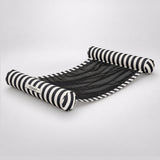
High humidity and the wet season mean anything that stays damp grows mould. Avoid materials that hold water, like bean bag fill and open foam. Choose a cover that sheds water and dries fast, such as solution-dyed Olefin, and make sure the float dries completely before you put it away. Mesh designs drain fastest, which is why the Sinka-Bit suits the tropics. Delivery details for Darwin, Cairns and Townsville.
Hot and dry: Perth, Adelaide and inland
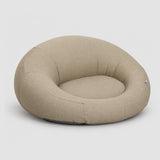
Extreme heat softens PVC, makes it too hot to touch and speeds up UV damage. A fabric cover stays more comfortable to lie on. Floats that keep you partly in the water help too. The Sinka-Bit sits you half in the pool, and the Floata-Round sinks you into a 70 cm seat. Store floats out of the sun between uses, because a hot paver or a sunny deck can damage them even when nobody is on them. See Perth and Adelaide.
Coastal: Gold Coast, Sunshine Coast, Byron Bay
Salt air, salt water pools and sand are hard on everything. Salt corrodes metal frames and valves, dries out plastics and leaves crystals that abrade fabric. Choose frameless floats with welded cores and chemically resistant fabric, and give them a fresh water rinse after use. Our salt water pool guide covers it in detail. Delivery to the Gold Coast, Sunshine Coast and Byron Bay.
Temperate south: Sydney, Melbourne, Canberra
Summers are shorter, but UV is still high, and floats spend more of the year in storage. That makes packability and proper winter storage important. A float that deflates and rolls is easier to keep than a bean bag or foam lounger. Dry it fully, roll it loosely and store it somewhere cool and dark. See Sydney, Melbourne and Canberra.
The material that works everywhere
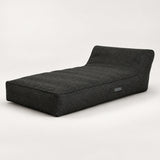
Solution-dyed Olefin over a welded TPU core handles UV, heat, salt, chlorine and humidity. It is what every Poolboy float is made from: the Floata-Long lounger, the Floata-Round seat float and the Sinka-Bit hammock. All ship free Australia-wide with 30 days to change your mind and a 12 month warranty. More on materials.
Care makes any material last longer
- Rinse off chlorine or salt after use.
- Dry in the shade, not on hot pavers.
- Keep sharp objects, jewellery and dogs' claws away from the surface.
- Store dry and out of the sun over winter.
Full routine in our cleaning guide, and see durable pool floats for more on what lasts.
FAQ
What pool float material is best for humid climates?
One with a quick-drying, water-shedding fabric cover such as solution-dyed Olefin, ideally with a mesh or open design that drains fast.
Is PVC bad for pool floats?
PVC is fine for cheap, short-term floats. In strong Australian sun it heats up, fades and becomes brittle faster than fabric covers.
What is TPU on a pool float?
Thermoplastic polyurethane, a flexible material used for inflatable cores. Welded TPU holds air well and is tougher than standard PVC.
Do salt water pools damage pool floats?
Salt can dry out plastics and corrode metal parts. Frameless fabric floats with welded cores handle it well, especially with a fresh water rinse after use.
